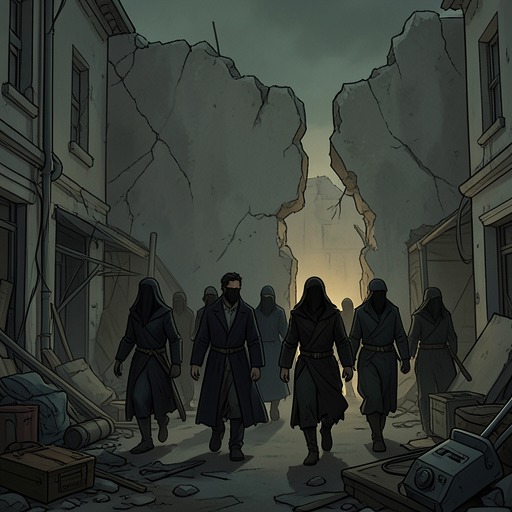
Colony battery-bank deterioration
The Passage (Justin Cronin Edition)The First Colony’s battery-bank deterioration turns a dependable-seeming utility into a countdown to darkness. Michael, the Colony’s electrical specialist, finds that the century-old storage cells are failing beyond repair; when they can no longer regulate power from the wind turbines, even a windless night could extinguish the lights. The crisis is not simply a technical defect: it threatens the settlement’s protection, exposes the limits of its inherited technology, and forces Michael to carry knowledge that the community is not prepared to hear.
The failure beneath the lights
The batteries have survived far longer than their intended service life, but age has not made them renewable. Michael watches their decline on the green bars of an old, battle-hardened CRT monitor. The wind turbines may keep spinning, yet generation is not enough: the batteries must store and regulate the current, and a night without wind could leave the Colony without power. Their apparent permanence has concealed an essential dependency.
Replacement is the only real remedy, and replacement is unavailable. The cells were made to be exchanged, not repaired. New gaskets, cleared corrosion, and rewired controllers cannot restore membranes whose polymer pathways have been clogged with sulfonic acid molecules. Michael recognizes the apparent maintenance work as futile against damage inside the battery itself. Without a new battery stack from the outside, the lights will go out; he estimates a year or two at most before total failure.
Michael carries the warning
Michael initially tells only Theo. He does not tell Gabe Curtis, formally the head of Light and Power but too ill to manage the shop, nor Sanjay, Old Chou, or even Sara, his sister. Michael and Elton have effectively been left to run the operation. His decision to confide in Theo reflects their friendship and may also be an attempt to find someone who can help him explain the coming disaster. The responsibility is stark: Michael imagines having to tell everyone that darkness means death, while knowing that he cannot prevent it.
Theo struggles to accept that the batteries are finite. To him, they have seemed as constant as the sun, sky, and walls: a natural fixture that Light and Power can simply fix whenever something goes wrong. Michael has to reduce the warning to its bluntest terms: “The Lights. Will. Go. Off.” The exchange captures the distance between the Colony’s dependence on its infrastructure and its understanding of that infrastructure. The lights are familiar enough to feel permanent, but the materials that sustain them are not.
The warning remains between the two men. They never speak of it again, though more than a year passes. During that interval Mausami marries Galen, rather than Theo; Michael remembers Theo’s expression on the porch and senses that something in him has gone out. The battery crisis does not cause that marriage, but Michael’s private knowledge gives the Colony’s happiness an uneasy counterpoint: ordinary life proceeds while the system supporting it continues to decay.
Confirmation and narrowing time
A later assessment makes the danger immediate and measurable. Battery number five is in the worst condition, while numbers two and three are somewhat better; batteries one and four show irregular charging. That morning the readings sit at twenty-eight across the board and never rise above fifty-five by First Bell. Elton translates the deterioration into a near-term forecast: brownouts within six months and total failure within thirty.
Elton also reveals that Michael’s father had seen the decline coming. He could read the batteries and had anticipated their failure long before Michael confronted the figures. The discovery turns the problem into an inheritance of knowledge as well as decaying equipment: the warning was legible to an earlier generation, yet knowing the trajectory did not make replacement possible. Michael responds with a familiar surge of panic and resists thinking about it, even as the numbers make postponement harder.
Energy, communication, and exposure
The battery emergency makes the Colony’s ban on radio newly consequential. Seventy-five years earlier, in the year 17, the radio was ordered destroyed because it had led the Walkers to the Colony. The antenna was taken down from the mountain, and its parts were chopped up and scattered in the dump. At the time, the restriction had a practical rationale: the Army knew where to find the settlement, while food, fuel, and space beneath the lights were limited. Michael can understand that earlier decision without accepting it as suitable to the present crisis.
Now the Colony may soon lose the lights, and the forbidden radio represents a severed route to communication beyond its walls. The settlement’s isolation and its failing power are linked vulnerabilities: one policy was intended to protect a community whose survival depended on controlled access and scarce resources, while the other depends on an aging system that cannot be renewed from within. The account does not present radio as a ready solution to the battery failure; instead, it shows how the past’s protective choices narrow the present’s options.
Failure becomes visible
When the lights unexpectedly go out, Michael initially races back through the dark to the Lighthouse expecting to find the system crashed. The control-room CRTs are still glowing and the meters remain in the green. The main breaker is open; Michael closes it, and the lights return. He reports a possible power surge to Ian at first light, but the system contains no record of one, and his checks uncover no fault that explains the interruption. The episode is distinct from the gradual battery decline, yet it gives the Colony’s dependence on power a brief, unnerving demonstration: darkness can arrive even when the instruments appear healthy.
The battery failure also belongs to a larger material vulnerability. During the escape by train, Michael shuts down the journey at Caliente, where the tracks end; the group has traveled about four hundred kilometers, and the maps Billie showed them indicated that the rails petered out there. This is not an effect of the Colony’s batteries, but it echoes the same limit: survival depends on infrastructure whose reach and reliability cannot be assumed. The battery-bank deterioration gives that limit its most intimate form. The lights are not merely conveniences; once their stored power is gone, the Colony’s carefully maintained security faces the prospect of darkness and widespread danger.